When paired with a Growatt battery, these panels not only generate more energy but also ensure efficient storage and optimal use of solar power.

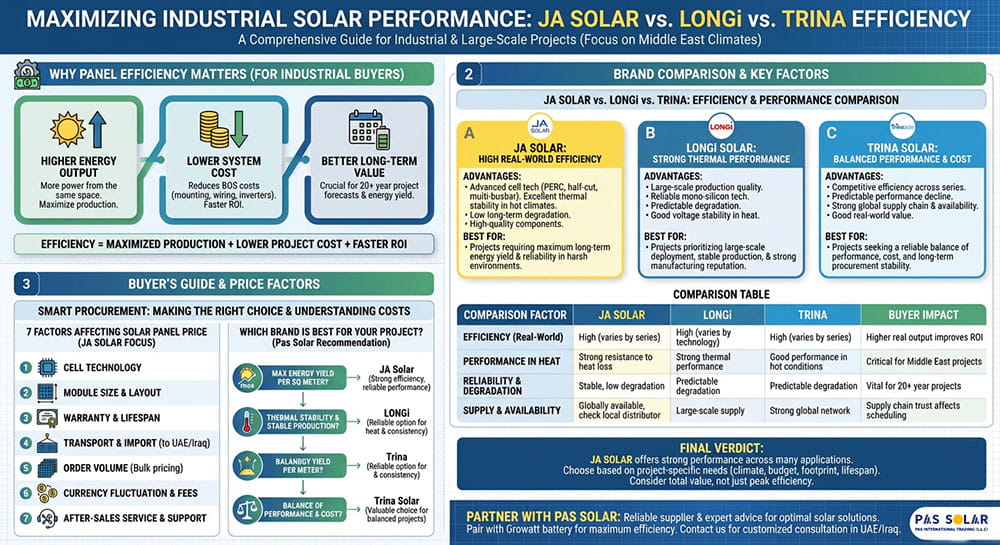
Understanding why panel efficiency matters, especially in industrial-scale and large projects, is so important when evaluating the efficiency of JA Solar panels and comparing them with LONGi or Trina. For large-scale solar systems, commercial factories, or high-consumption industrial areas, panel efficiency goes beyond a mere technical metric, making it a crucial advantage. For engineers, distribution managers, and solar contractors around the Middle East, like Iraq & the UAE, more efficient panels deliver higher power output for the same space, cut down installation and system costs, and improve long term return on investment. When buying in bulk, even a small difference in efficiency can affect the whole project’s production over time.
| Section | Key Points | Practical Tips | User Benefits |
|---|---|---|---|
| Why Panel Efficiency Matters | Higher energy output for the same space, lower installation & system cost, quicker ROI | Focus on efficiency for industrial-scale & high-consumption areas | Maximize power production, reduce project cost, and achieve faster ROI |
| JA Solar Efficiency Factors | Advanced cell technology, high-quality materials, thermal stability, and long-term reliability | Choose panels with verified real-world performance | Consistent output, less heat-related loss, reliable for decades |
| JA Solar vs LONGi | Both JA Solar and Longi offer high efficiency, varying by module series.
Durability: Both brands provide stable long‑term performance with predictable degradation rate. Supply: Local availability and supply‑chain reliability may influence procurement decisions. |
Compare module series and temperature coefficients | Choose a brand based on project climate and longevity needs |
| JA Solar vs Trina | Efficiency: Both JA Solar and Trina offer high efficiency depending on module series.
Durability: Both brands provide stable long‑term performance with predictable degradation. Supply: Local availability and supply‑chain reliability may influence procurement decisions |
Check local sourcing & supply chain reliability | Ensure consistent delivery, long-term ROI |
| Operational vs Lab Efficiency | Lab efficiency vs real-site performance | Focus on real operational results | Accurate energy forecasts, better project planning |
| Key Factors Affecting Price | Cell technology, module size & layout, warranty & lifespan, transport/import costs, order volume, currency fluctuations, after-sales service | Evaluate the total project cost, including logistics and warranty | Optimize investment, avoid hidden costs, and ensure support |
| General Efficiency Comparison | JA Solar: High efficiency (varies by series), performs well in high‑temperature environments, low annual degradation.
LONGi: High efficiency (varies by series), strong thermal performance, predictable long‑term output. Trina: High efficiency (varies by series), good real‑world performance across multiple applications. |
Select based on project scale, climate, and energy needs | Maximize production, reduce maintenance, ensure long-term reliability |
| Choosing the Right Brand | Balance efficiency, thermal performance, reliability, cost, and supply chain | Consider climate, project size, budget, and warranty | Informed selection, optimal long-term energy output, minimized risk |
JA Solar has a global reputation for producing high-quality solar panels across multiple product series. Although exact efficiency varies by series and cell technology, JA Solar panels remain competitive when compared with other major players in the market. Thanks to advanced manufacturing techniques, good material quality, and careful cell engineering, their typical modules achieve high energy conversion rates in real-life operational conditions. These efficiencies help maximize output from a given installation footprint — which is exactly what large-scale buyers need.
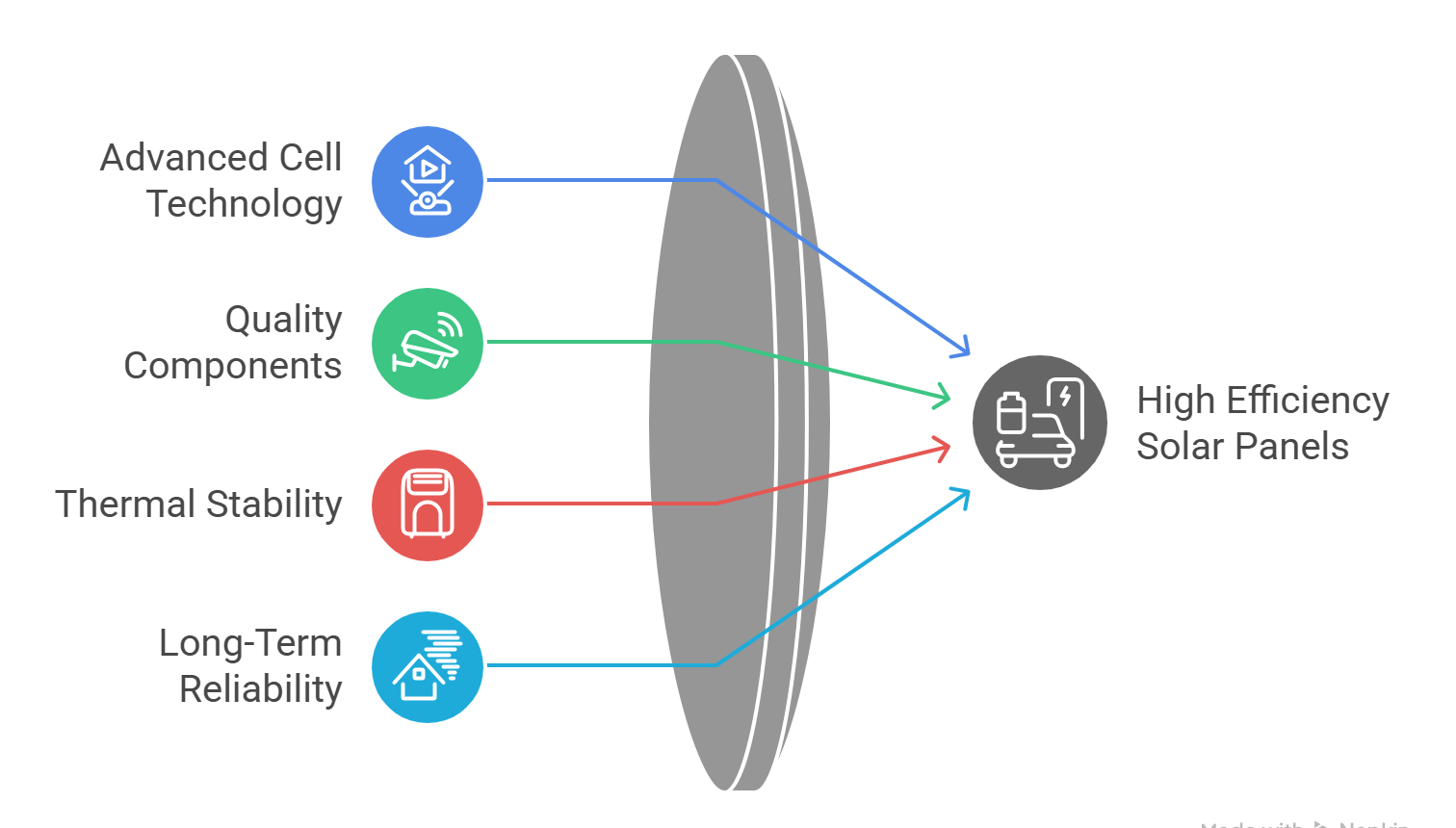
To reach these reliable performances, JA Solar depends on a few key factors:
JA Solar uses modern cell technologies across its product lines, including PERC, half‑cut cells, and multi‑busbar designs. These technologies reduce energy loss and help more captured photons turn into usable electricity.
For solar panels to reach high efficiency, they require not only advanced cell design but also superior materials: high-purity silicon, modern passivation layers, and anti-reflective coatings. The scale of JA Solar and careful quality control help their modules maintain performance over time.
Solar panel efficiency isn’t only about the best conditions: it’s about how panels work under actual conditions, especially high temperatures. The design of JA Solar panels helps reduce performance losses at high temperatures, which is beneficial for industrial applications.
Major buyers care not only about peak efficiency but also about how reliably panels deliver power year after year. By focusing on quality materials and the choice of components, support consistent performance decline, which is important for long-term solar projects
| Comparison Factor | JA Solar | LONGi | What It Means for the Buyer |
|---|---|---|---|
| Efficiency (Real-World Use) | High real-world efficiency depending on module series with strong long-term energy output | Very competitive efficiency, varies by cell technology | Higher real output improves ROI in large-scale projects |
| Performance in High Temperatures | Designed to minimize performance loss in hot climates | Strong thermal performance in hot environments | Both brands are suitable for Middle East conditions |
| Reliability & Degradation | Stable and low degradation over time based on datasheet value | Predictable degradation with consistent manufacturing quality | Long-term reliability is critical for 20+ year projects |
| Manufacturing Scale & Quality | Advanced cell engineering and quality control | Large-scale production with proven cell technology | Ensures consistent module quality |
| Strategic Value for Large Projects | Suitable choice for long-term investment and stable efficiency | Reliable option balancing cost and performance | Decision depends on supply chain trust and warranties |
| Best Use Case | Projects focused on maximum long-term energy yield | Projects prioritizing production scale and supply stability | Match brand to project priorities |
When evaluating JA Solar versus LONGi, both brands work well, but their strengths and benefits vary across different areas.
| Comparison Factor | JA Solar | Trina Solar | What It Means for Industrial Buyers |
|---|---|---|---|
| Efficiency (Real Conditions) | Strong efficiency due to modern cell design and strict material quality control | Competitive efficiency supported by advanced panel series | Actual energy output depends on site conditions and module type |
| Durability & Degradation | Designed for long-term stability with low degradation | Predictable degradation and reliable long-term performance | Critical for projects with 20+ year ROI planning |
| Industrial Project Reliability | Consistent output suitable for large-scale installations | Proven reliability in utility-scale projects worldwide | Reduces long-term operational risk |
| Supply & Availability | Globally available; dependent on trusted local distributors | Strong global supply network and availability | Supply chain trust and lead time affect project scheduling |
| Long-Term Value per Panel | Long term energy yield | Balanced performance and cost over panel lifespan | Better lifetime output improves investment returns |
| Best Use Case | Projects prioritizing long‑term performance and reliability | Projects balancing performance, cost, and availability | Helps align brand choice with project goals |
Looking at JA Solar versus Trina Solar panels adds another aspect, which is especially relevant for major industrial projects:
If you are a buyer in the industrial energy space, these are the main factors to evaluate panel efficiency:
For reliable performance under the sun, buying a solar panel in Dubai is also a smart choice.

Instead of focusing just on cost, here are some important factors that influence the price of JA Solar modules, especially relevant for project developers:
| Brand | Typical Efficiency Range | Performance in Heat | Degradation Behavior | Suitability for Large Projects |
| JA Solar | Very high | Strong resistance in hot areas | Stable performance with low decline over time | Very attractive for industrial installations |
| LONGi | High | Good voltage stability | Predictable reduction in output as panels age | Reliable option with a strong manufacturing reputation |
| Trina | High to moderate | Good performance in actual operating conditions | Stable and dependable | Great value for large-scale long-term procurement |
For some Engineers at Pas Solar, the choice of brand ultimately means balancing performance, reliability, and supply chain confidence:
Ultimately, the right pick depends on your specific project conditions: climate, financing, installation footprint, and expected lifetime.
In summary, the efficiency of JA Solar panels is a major strength, especially for industrial-scale buyers. When we compare JA Solar with LONGi or Trina, it’s clear they all offer high conversion efficiency, durability, and trustworthy performance in challenging situations. LONGi, Trina, and JA Solar all offer high‑efficiency modules suitable for industrial projects. The best choice depends on project requirements, climate, budget, and module availability, with JA Solar offering strong performance across a wide range of applications.
For leaders at Pas Solar, understanding panel efficiency impacts is not just about numbers. The focus is on choosing both a reliable supplier and a panel that performs well over time. When making your selection, focus on more than just peak efficiency; you should look at the efficiency to how they perform over time, age, and fit into your overall plan.