JA solar panels are designed to provide clean, renewable energy with minimal ecological impact, making them a sustainable choice for both homes and businesses.

The rapid growth of renewable energy made solar panels one of the most discussed technologies of the past decade. So, it has led many to ask: Are solar panels bad for the environment? While this green technology is widely recognized as a sustainable alternative to fossil fuels, there are still concerns regarding its overall ecological footprint. To form a balanced perspective, it is important to look at both the positive and negative impacts of solar energy on the environment, its side effects on human health, and the reasons why solar panels are ultimately considered beneficial for this planet.
Choosing a trusted Solar panel distributor ensures high-quality panels with a minimal ecological footprint.
| Factor | Positive Impact | Negative Impact | Why It Matters |
|---|---|---|---|
| Air & Climate | Zero emissions during operation, reduces greenhouse gases | Emissions during manufacturing | Shows the true carbon footprint of solar panels |
| Land Use | Rooftop solar requires no extra land | Large solar farms may disrupt ecosystems | Helps evaluate environmental trade-offs |
| Human Health | Cleaner air, fewer respiratory issues | Chemical exposure risks during production | Important for safety & public health |
| Resource Use | Uses renewable sunlight; long lifespan | Needs rare materials like silicon & cadmium | Highlights sustainability challenges |
| Water Consumption | Very low water use compared to coal/nuclear plants | Some water is needed for cleaning | Critical in dry regions |
| Waste & Recycling | Panels last 25–30 years | Disposal and recycling remain limited | Important for long-term environmental planning |
| Energy Payback Time | Offsets emissions within 1–3 years | Manufacturing emissions are initially high | Shows solar is beneficial long-term |
| Biodiversity | Can be combined with farming (agrivoltaics) | Poorly planned farms reduce biodiversity | Affects wildlife and ecosystems |
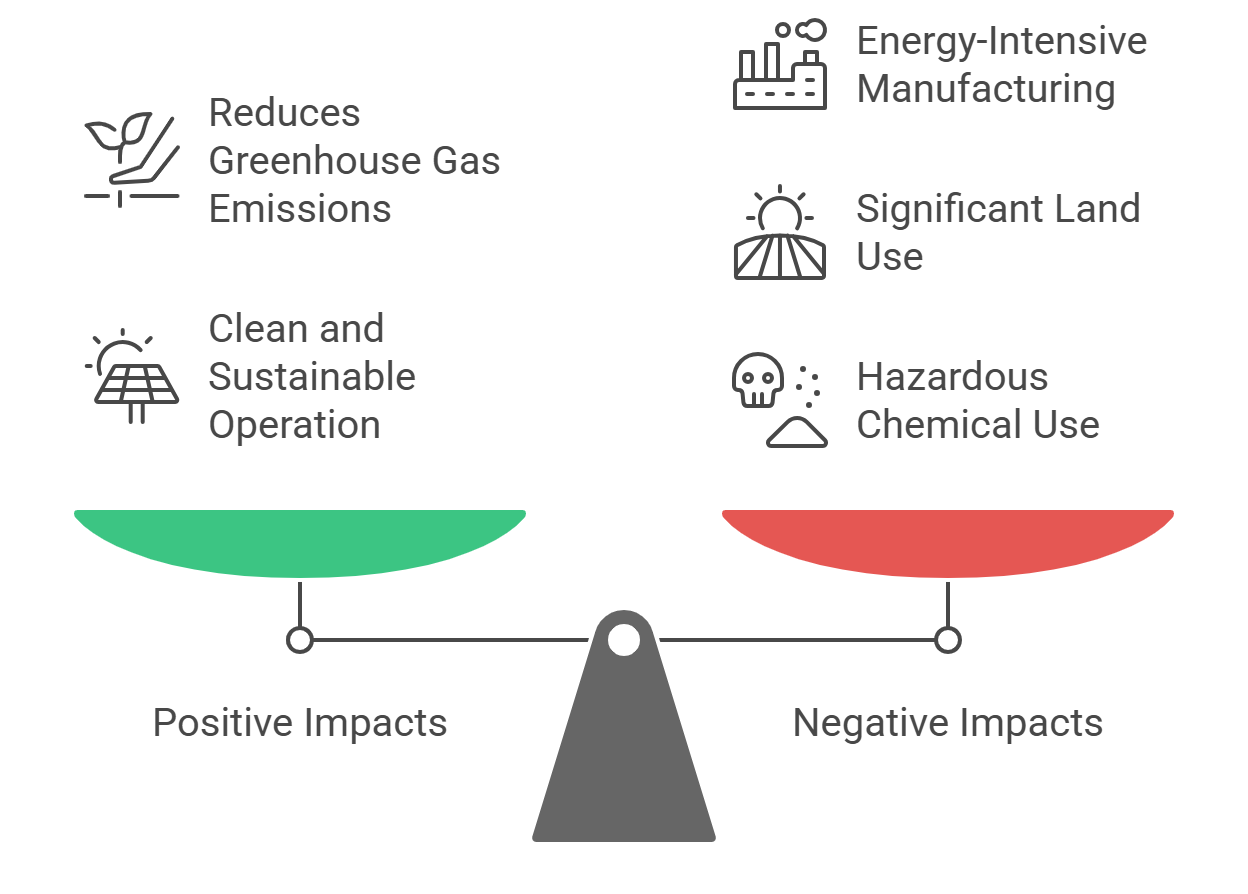
When examining the positive and negative impacts of solar energy on the environment, it is essential to figure out the full life cycle of solar panels, from production to installation and disposal. Therefore, this evidence shows that solar power brings both opportunities and challenges.
On the positive side, solar energy produces electricity without burning fuel, and on the other hand, it can reduce greenhouse gas emissions. Unlike coal or natural gas, it does not release harmful pollutants such as carbon dioxide, sulfur dioxide, or nitrogen oxides into the atmosphere to endanger the planet. This reduction directly contributes to slowing climate change and improving overall air quality.
On the negative side, the manufacturing process of solar panels requires energy-intensive operations, often involving the use of hazardous chemicals like lead and cadmium. Additionally, ground-mounted solar farms may require significant land use, which could disrupt local ecosystems if not carefully managed.
So, are solar panels bad for the environment? The answer is not absolute. Their operation is clean and sustainable, but their production and disposal do come with environmental costs.
Looking deeper into how solar energy affects the environment, we need to look at both the direct and indirect effects.
However, with innovative technologies like placing panels on rooftops or combining farming with solar installations (agrivoltaics), many of these environmental challenges can be solved or minimized. Compared to fossil fuels, the ecological impact of solar power is considerably lower
Some people specifically ask: Are solar panels bad for the atmosphere? The short answer is no, and the evidence can not show this. In fact, solar energy is one of the cleanest technologies available when it comes to air quality. Unlike coal or gas plants, solar systems operate without producing harmful emissions.
The only potential atmospheric impact comes during manufacturing, where greenhouse gases may be released. But studies show that within one to three years of operation, solar panels “pay back” the emissions generated during their manufacturing. Considering that panels last 25–30 years on average, the long-term effect on the atmosphere is overwhelmingly positive.
While the environmental aspects are vital, we must also consider the side effects of solar panels on humans. For the average user, solar panel systems are safe and do not pose any health risks. Unlike fossil fuels, they do not contribute to respiratory diseases or cardiovascular illnesses caused by air pollution.
The main human-related concerns involve exposure to chemicals during the panel manufacturing stage. Workers in solar factories may be exposed to certain chemicals that are risky if safety protocols are not strictly followed. For households and businesses, however, solar panels pose virtually no health risks, as they are designed to be stable and non-toxic under normal conditions.
Electromagnetic fields (EMFs) from solar systems are also sometimes mentioned, but studies confirm that their levels are significantly lower than those from everyday household devices like mobile phones, microwaves, and Wi-Fi routers.
Despite the concerns, it is crucial to highlight why solar panels are good for the environment. The long-term benefits of solar energy far outweigh its drawbacks when looking at the bigger picture.
These factors make solar power one of the most promising technologies for building a cleaner and achieving sustainable global energy future.
|
Aspect |
Positive Impact |
Negative Impact |
|
Air & Climate |
Zero emissions during operation (Reduces greenhouse gases) | Emissions during manufacturing |
|
Land Use |
Rooftop solar saves space |
Large-scale farms may disrupt ecosystems |
|
Human Health |
Cleaner air decreases illnesses |
Risks for workers during production processes |
|
Resource Use |
Renewable, sunlight is endless |
needs rare materials like silicon, cadmium |
| Lifespan | 25–30 years of clean energy |
Disposal and recycling challenges |
So, are solar panels bad for the environment? The evidence suggests that while they are not entirely impact-free, the long-term environmental and social advantages are far greater than the drawbacks. By decreasing greenhouse gases, improving air quality, and offering an abundant energy source, solar panels stand out as one of the best tools we have to combat climate change.
By addressing the positive and negative impacts of solar energy on the environment, the side effects of solar panels on humans, and especially why solar panels are good for the environment, we can see that the overall effect of solar technology is strongly positive. With advancements in recycling and better manufacturing practices, the environmental footprint of solar technology will continue to shrink.
While solar panels provide clean energy and reduce emissions, using a Solar Lithium Battery in UAE ensures efficient energy storage with minimal ecological impact, making solar power a sustainable choice for homes and businesses.