
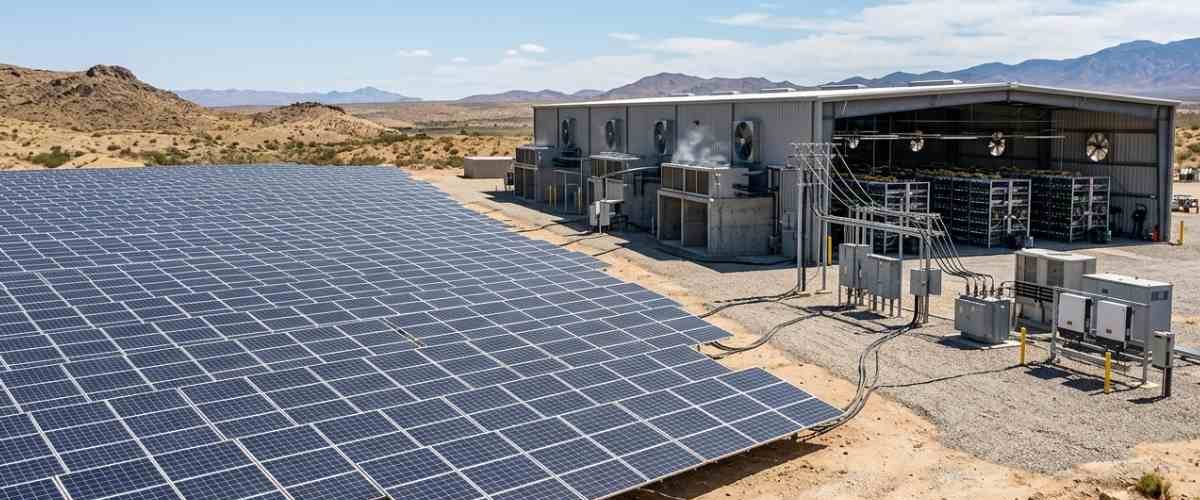
These days the price of energy continues to rise globally, crypto mining is now strongly dependent on electricity consumption and energy costs. In today’s mining industry, profitability relies not only on hardware performance or crypto prices, but also on energy strategy and system design
So most miners are asking this question: Is solar power cost-effective for crypto mining?
The answer can vary based on the system and conditions, such as the design of solar energy, storage, and consumption of a mining system.
Crypto mining, especially solar powered bitcoin mining, is a continuous high load process that needs stable and uninterrupted energy supply. Mining devices such as ASICs and GPU rigs operate continuously (24/7) and their energy demand is different based on the scale of the system, from small home systems to large industrial mining ones.
Because of this constant energy demand:
| Factor | Impact on Mining Operation | Effect on Profitability |
|---|---|---|
| High Electricity Cost | Increases operational expenses | Reduces ROI and may make mining unsustainable |
| Low Electricity Cost | Enables continuous operation | Improves long-term profitability |
| Energy Efficiency (ASIC/GPU) | Determines power usage per hash rate | Directly improves profit margins |
| 24/7 Energy Demand | Requires stable power supply | Increases importance of energy planning |
| Solar Energy Integration | Reduces dependency on grid electricity | Stabilizes long-term cost structure |
| Battery Storage Systems | Ensures continuous mining during night/cloudy periods | Improves uptime and revenue consistency |
In many cases, the relationship between cost of energy and profitability of mining is very direct:
This is where solar panel lithium battery systems for crypto mining—and more broadly renewable energy crypto mining—changes from an environmental concept into a strategic financial model.
A solar mining system is not just some panels which are connected to a miner. It is a complete energy system that needs careful design to ensure proper balance between energy production, storage, and mining demand.
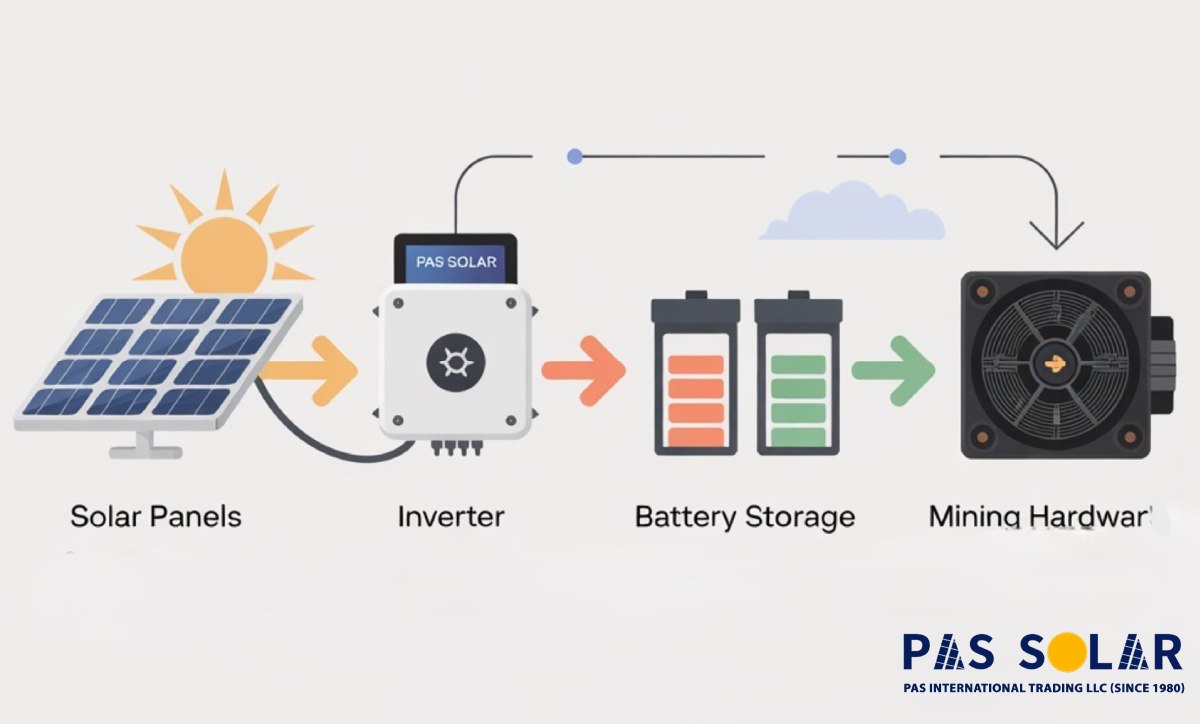
A solar mining system consists of several key components, each part playing a specific role in the overall energy flow:
However, the main challenge is not about installation, it is related to energy balancing. Solar energy is variable and also it totally depends on the condition of weather, while mining demand is constant and uninterrupted.
This mismatch makes system design very important, especially in off grid solar mining setups, where the system works without the grid, and hybrid solar mining setups, where solar power is combined with grid or backup energy.
At this stage, proper engineering becomes essential. Some companies like Pas solar design the systems based on real patterns of energy consumption, not just theoretical data.
A simple but often ignored advantage of solar systems is that they can generate more energy than needed which is called excess energy production.
In many places, especially residential and sometimes commercial projects, solar panels generate more electricity during the day than is immediately consumed.
In traditional setups, extra solar energy usually doesn’t generate much value. It’s often sent back to the grid or sold at low costs. But in crypto mining, that same energy can be used more effectively.
Instead of letting it go to waste or selling it cheaply, it can directly power mining operations and create a more meaningful return. This is one of the main reasons of improved solar mining profitability, especially in locations where selling electricity back to the grid isn’t financially attractive
In order to evaluate profitability, it is essential to understand the cost of solar mining setup. Instead of fixed pricing which are not realistic for all users, real systems are produced based on structure, energy needs, and real world conditions:
A solar mining system usually includes different key cost factors:
the real cost of a solar mining system can be varied based on several factors in real worlds:
This is why the system that has customized design is more reliable than standard packages.
|
System Factor |
Impact on Cost |
Impact on Profit |
| Solar capacity | High upfront expense | Long term cost reduction |
| Battery storage | High expense | Continuous mining capability (24/7) |
| Mining hardware | Medium expense | Income generation |
| System structure | Critical cost component | System efficiency boost |
The profitability of solar mining is not only about energy production, it is about energy utilization efficiency.
Important factors that has influence include:
In highly optimized systems, solar mining can:
It is important to understand both aspects clearly: solar mining is not a short term profit but a long term energy optimization strategy.
Choosing the correct system structure is one of the most important decisions in solar mining.
These types of systems have lower upfront expense and are connected to the main grid, which acts as a backup power source when solar production is not enough. They are also easier to expand in the future as the project grows.
Off-grid systems work completely independently from the electricity grid, providing full energy independence. However, they need battery storage to ensure continuous operation, which leads to higher initial investment costs.
Hybrid systems combine solar power, grid electricity, and battery storage into one setup. This makes them the most stable and flexible configuration, especially for real world crypto mining projects.
Most of the time, hybrid systems provide the best balance between cost and reliability.
Solar mining is really dependent on geography and location.
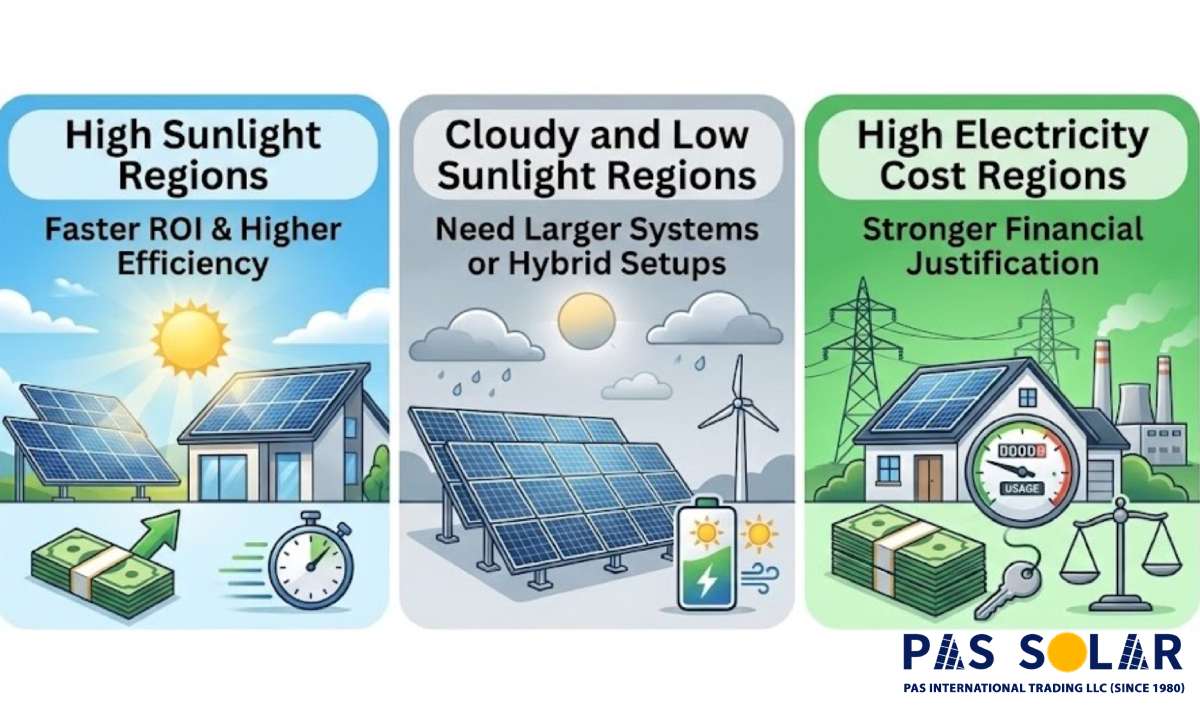
Even with the same system design, performance can vary significantly based on environment.
One of the main but often ignored benefits of crypto mining is heat generation.The mining system converts almost all electricity into heat energy.
Instead of wasting this energy, it can be reused for:
This transforms mining into a dual-output system: This transforms mining into a system with two outputs:
So, in colder climates, this can improve the efficiency of the overall system.
Despite all of the advantages, solar mining has some limitations:
Because solar energy is not constant, battery storage or hybrid systems are needed to keep continuous and stable operation.
Poor design can result in wasted investment or lower efficiency.
Not every location can support large solar arrays due to space or structural limitations.
Mining rigs need proper ventilation and thermal control to work efficiently. These challenges are not major obstacles, but they must be handled with good system design. This is where structured design approaches like those used by Pas Solar become important.
Modern solar mining systems are no longer static. They use advanced strategies like:
This makes mining a real time energy optimization system instead of a fixed operation
Now let’s compare the solar mining system with traditional ones:
|
Factor |
Traditional Mining |
Solar Mining |
| Energy cost | High and volatile | Low and stable |
| Predictability | Low | High |
| Scalability | Cost dependent | Design dependent |
| Long-term ROI | Uncertain | More stable |
This is why solar power for crypto mining is becoming a strategic alternative to traditional grid electricity.
So, is solar power cost-effective for crypto mining? Most of the time the answer is positive as long as the crypto mining is under proper engineering conditions.
Solar mining becomes effective when:
Without suitable design, even large solar installations can not work well. But with the right approach, solar power has the potential to reshape crypto mining economics .
Solar mining not only reduces electricity costs, but also becomes a complete energy optimization framework. Companies like Pas Solar focus on transforming solar energy into structured and scalable systems that are economically optimized.
Yes, it can be profitable when the system is properly designed, energy storage is optimized, and excess solar energy is efficiently used. Profitability depends on location, sunlight availability, and mining efficiency.
The main costs include solar panels, battery storage, inverters, mining hardware, and installation. Battery storage and solar capacity usually represent the highest initial investment.
Yes, but only with a hybrid or off-grid system that includes battery storage or grid backup. Since solar energy is not constant, energy storage is essential for continuous operation.
Energy-efficient ASIC miners are generally the best option because they provide higher hash rate per watt, making them more suitable for solar-based systems.
The biggest challenge is energy balance, since solar energy is variable while mining requires constant 24/7 power. Proper system design and storage solutions are required to solve this issue.
Solar mining is generally a long-term energy optimization strategy rather than a short-term profit model, due to the high initial setup cost and long payback period.
Is solar power for crypto mining profitable?
What are the main costs of a solar mining system?
Can crypto mining run 24/7 on solar energy?
What type of mining hardware works best with solar power?
What is the biggest challenge in solar powered crypto mining?
Is solar mining a short-term or long-term strategy?