
Solar panels do not need direct sunlight to generate electricity. Although direct sunlight improves efficiency, modern solar panels can still work in cloudy weather, indirect light, and partially shaded conditions. In this guide, we explain how solar panels perform in different lighting conditions and what really affects solar efficiency.
Every solar panel contains photovoltaic (PV) cells. When solar panels are exposed to sunlight, it generates electricity through photovoltaic (PV) cells. Instead of needing heat or fuel, the cells react directly to light particles (photons) and turn them into electrical energy for homes, devices, or the power grid. Solar panels generate electricity through a simple but highly efficient process based on converting sunlight into electrical energy using photovoltaic cells.
| Step | Process | What Happens |
|---|---|---|
| 1 | Sunlight hits panel | Photons reach photovoltaic (PV) cells |
| 2 | Energy absorption | PV cells absorb light particles |
| 3 | Electricity generation | Direct current (DC) is produced |
| 4 | Conversion | Inverter converts DC to AC electricity |
| 5 | Power usage | Electricity is used in home or stored in battery |
What is important here is that they don’t need heat or perfect sunshine, they need just light. So even when the sunlight is not direct, such as cloudy days or in shaded regions, there is still energy available to be captured. However, their performance drops compared to direct sunlight conditions.
Not really. Although direct sunlight helps, of course and lets you experience the highest output, it’s not a requirement for the system to work well.
In simple terms:
|
That’s why solar systems are still usable in different environments with different weather patterns, even in places where the weather is not perfectly sunny all around the year. At Pas Solar, our system design is based on this reality, not around ideal conditions. Solar panels can still generate electricity under different lighting conditions, but the level of performance changes depending on sunlight intensity and weather conditions.
| Weather Condition | Estimated Solar Output | System Performance |
|---|---|---|
| Direct Sunlight | 90–100% Output | Maximum efficiency |
| Light Cloud Coverage | 60–80% Output | Stable performance |
| Heavy Cloud Coverage | 10–40% Output | Reduced energy generation |
| Partial Shade | Depends on shading level | Lower efficiency |
| Night Time | 0% Output | Requires battery or grid backup |
As shown above, solar panels do not completely stop working in cloudy or indirect light conditions. Instead, the amount of electricity generated changes based on available sunlight.
Even when the sun isn’t directly shining on the panels, reflected and diffused light still reaches the surface. This is what we call indirect sunlight solar panels performance.
You will experience this in everyday conditions such as:
If there is daylight, there is still available energy. The output might not be at the peak hours, but the system is still working.
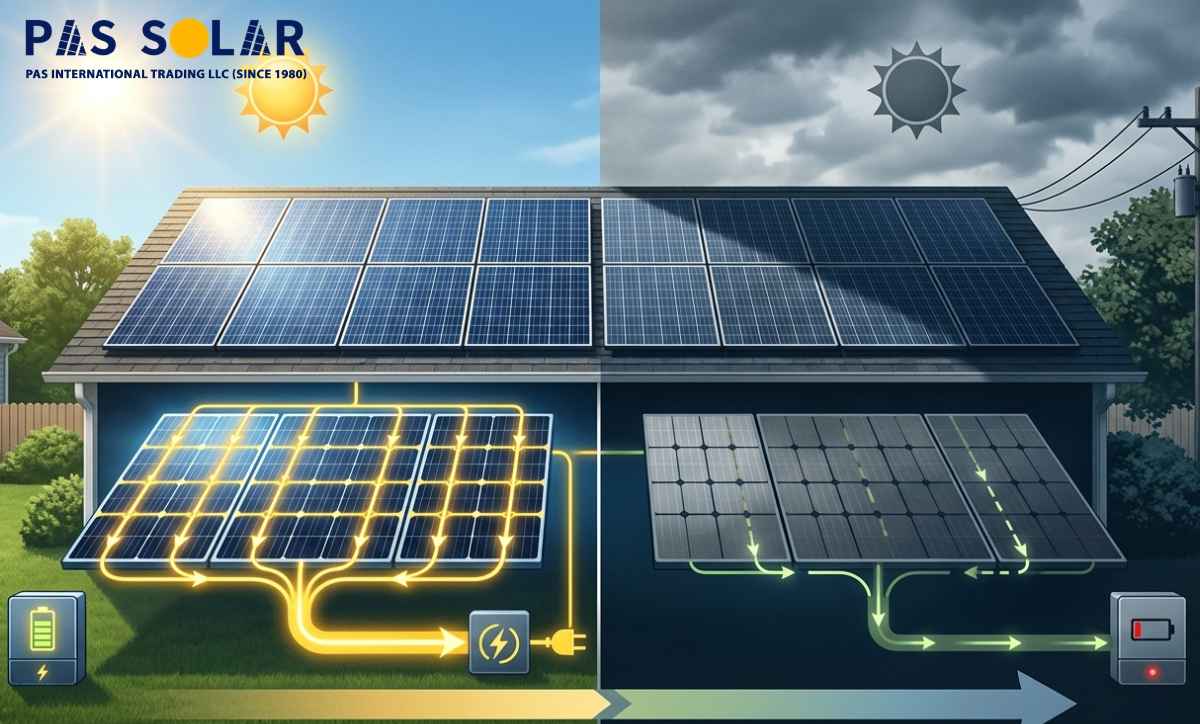
Cloudy weather doesn’t stop solar energy, although it can reduce how much sunlight reaches the surface.
The performance of solar panels in cloudy weather depends on the extent of cloud coverage. Light clouds have a low effect on output, while heavy clouds can reduce production more noticeably. Even under these conditions, solar panels continue to produce electricity, because sunlight doesn’t disappear, it is only spread out and diffused.
At Pas Solar, systems are designed to manage these fluctuations. Considering the ja solar panel price, energy production is not only ideal under perfect conditions and highly cost-effective, but also remains stable over time.
The solar panel efficiency sunlight relationship is directly dependent on sunlight intensity. Energy production can increase with stronger sunlight and it can decrease when light intensity is lower. This is why solar systems have the best performance during daylight, especially peak hours (when the sun is strongest and most direct.)
But whatever is more important in real life is the concept of consistency, not just peak performance. Even under changing weather conditions, a well-designed system can maintain strong annual performance.
Shading is one of the most significant factors affecting solar performance. Proper system design plays a major role in maintaining stable solar performance in shade, especially in areas affected by trees, buildings, or partial rooftop shading. Even small shadows from some obstacles such as trees, buildings, or rooftop can reduce output. but how much it impacts performance depends more on system design.
Several technical and environmental factors can affect solar panel efficiency. In many cases, system design has a bigger impact on long-term performance than weather conditions alone.
| Factor | Impact Level | Description |
|---|---|---|
| Sunlight Intensity | High | Stronger sunlight increases energy production |
| Panel Angle & Orientation | High | Proper positioning improves solar exposure |
| Shade | Very High | Even partial shading can reduce output |
| Temperature | Medium | Excessive heat may lower efficiency |
| Dust & Dirt | Medium | Dirty panels block sunlight absorption |
| Inverter Quality | High | Better inverters improve energy conversion |
For systems that need both efficient energy conversion and battery support, the growatt 12kw hybrid inverter single phase can be considered as an option depending on the project’s power requirements and system design.
Because of these factors, high solar performance is not only about sunny weather. A properly designed system can maintain reliable energy production even in changing environmental conditions.
At Pas Solar, we can reduce this problem by selecting advanced inverters, optimizing panel level, and designing strategic systems. This method helps to prevent the common problems where one shaded panel affects the entire system.
Most of the people get confused here. Solar panels do not produce electricity during the night because there is not any light. However, during the day, even without direct light, they still work. So when we talk about solar power without sun, we are actually talking about systems that rely on:
Therefore modern solar systems are able to provide uninterrupted energy.
Some people think that solar performance depends only on sunshine, but that is not true. In reality, it depends more on how the system is designed.
At Pas Solar, every system is designed based on roof angle and direction, shading analysis , local weather conditions, and energy usage requirements. This is what separates high performance systems apart from basic installations.
This is what makes the difference between a basic installation and a high performing solar system.
Yes, there is some evidence across different regions that can prove it. Even where strong sunlight is not constant, solar energy still reduces electricity expenses significantly during the time. As we said before, the main thing is not perfect sunlight, in fact it is proper system design.
So, do solar panels need direct sunlight? No, they don’t. While solar panels work well under direct sunlight, they are so adaptable. They can still produce electricity under clouds, in shade, and in indirect light conditions. What is really crucial is not just the weather patterns, but how well the system is built to handle them.
At Pas solar, this is exactly what we focus on:
creating solar systems that work in real conditions, not only the ideal ones.
No, solar panels do not need direct sunlight to generate electricity. They can still produce power from indirect sunlight, although the efficiency will be lower compared to direct sunlight conditions.
Solar panels work by capturing photons from daylight, not heat. This means they can still generate electricity during cloudy weather or in diffused light conditions, even without direct sunlight.
On cloudy days, solar panels typically produce between 10% and 80% of their normal output, depending on cloud thickness and weather conditions. Light clouds have minimal impact, while heavy clouds reduce performance significantly.
Yes, solar panels can still work in shade, but their output will decrease. Partial shading can significantly reduce system efficiency, which is why proper system design is very important for stable performance.
Solar performance in shade refers to how efficiently solar panels generate electricity when they are partially or fully shaded. Even in shaded conditions, panels can still produce energy, but at a reduced rate depending on system design and inverter technology.
No, solar panels do not produce electricity at night because there is no sunlight available. To supply energy during nighttime, battery storage systems or grid connection are required.
Yes, indirect sunlight is enough for solar panels to generate electricity. While output is lower compared to direct sunlight, modern solar panels are designed to utilize diffused light effectively.